

Herbicidal Spraying, Foliar Application and Stem Injection
When ever possible we try to avoid using herbicides, however, there are time when it is neccessary. What follows is a guide to how we use herbicides to control ivy.
Ivy has a very thick, waxy cuticle which is very resistant to foliar applied (leaf wipe) herbicides. Glyphosate is the herbicide of choice which is found in such products as Roundup Pro Biactive.
For Maximum Effectiveness with Foliar Applications
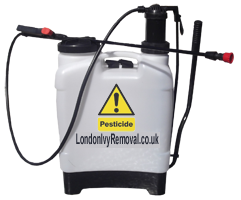
- Apply on new soft leaf growth - April/May
- Herbicide application at the highest rate is recommended
- Using a 2% concentration of a wetting agent such as Mixture B is recommended
- The wetting agent increases the penetration of Glyphosate into the waxy cuticle
- Repeat the treatment over three years
- Cut the ivy at the stem base and use herbicidal stem injection to kill the roots
Treating Mature 'Woody' Ivy
Thick woody trunks on Ivy should be treated in the dormant season, which is generally November to February. The ivy is cut at the base and Gylphosate is immediately applied with a brush. It is important to do it straight away as the ivy will seal the cut after 10 minutes, making Glyphosate absorption impossible.
Chemical Thinning
Concentrated Glyphosate is introduced straight into the ivy through a axe cut into the bark, still leaving the plant intact. A Spot gun with a solid stream nozzle is recommended and it is advisable to make a second cut under the first to catch any surplus herbicide.
Work out how many hatchet cuts are needed according to the diameter of the trunk and space them round the girth. e.g. trunk of 20cm diameter requires 2 cuts. Alternatively the concentrate can be introduced through an 8mm drill hole, about 40mm long, aimed slightly downwards and radially towards the centre of the stem.
Why Choose Us?
We work for property developers, landlords, landscape architects, garden designers, local councils such as Camden and have many, many happy customers.
- We have vast experience in the correct application of herbicidal spraying
- Our team are all fully NPTC qualified on the lawful use of pesticides
- We are Licensed Waste Carriers which is a legal requirement for removing hazardous waste such as Japanese Knotweed and disposing in a bio secure manner at suitable landfill sites
- We have a wow factor client list
- Checkable list of references available from our many happy customers
Give us a call for some friendly help and advice. Over 90% of our work comes through recommendation - a fact that speaks volumes.


